

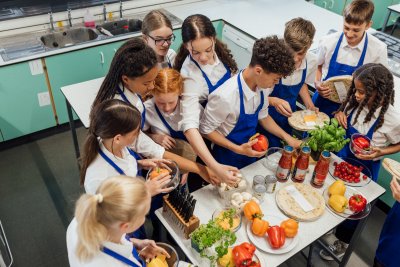
 Serving up healthy school meals. Copyright: © 2023. Provided by Impact on Urban Health licensed via CC BY-NC-ND 4.0 license. Credit:


Wales shows the power of universal primary school meals
Evaluation of the universal primary school meals programme in Wales has found that the policy is helping to ease household budgets, as well as supporting children’s wellbeing and learning. Children's Food Campaign responds.
Universal Primary Free School Meals (UPFSM) in Wales guarantee every primary school pupil a free, nutritious lunch each day, with no means testing or eligibility checks and no stigma. The programme was rolled out between September 2022 and September 2024, making Wales the first nation of the UK to achieve full universal provision of meals in primary schools.
The Welsh government's evaluation of Year 1 of the policy has now found that for families this is helping to ease financial pressures amidst a cost-of-living crisis, especially for families just above previous eligibility thresholds who no longer have to spend money on packed lunches or paying for school meals.
For pupils, the policy is also contributing to a more inclusive learning and dining environment with uptake now averaging 69% of pupils.
Wales' Cabinet Secretary for Education, Lynne Neagle said:
"Universal Primary Free School Meals are making a real difference to families, schools and learners right across Wales. This evaluation shows we are not only easing financial pressures on households but also creating more inclusive school environments where every child can enjoy a nutritious meal together.
Ensuring children are well-fed supports their ability to learn and thrive, and I'm pleased that our continued investment in this policy means we are building on these positive early findings to deliver even better outcomes for our learners."
Some schools are also reporting additional benefits, with universal provision reducing stigma around free school meals and with some teachers and schools noting that pupils return to lessons more focused and settled after eating a healthy lunch alongside their classmates.
At Garnteg Primary School, Headteacher Sue Roche, who has seen the changes first hand, said:
"Universal Primary Free School Meals at Garnteg primary School is a great way for children to enjoy a delicious meal at lunch, whilst socialising with their peers. The impact is great for giving the pupils the best start to their day and ensuring learners are in school ready to learn whilst enjoying a hot nutritious meal at lunchtime ready for their afternoon session.
It is also particularly valued by families as it also encourages children to try new foods and ensures every child receives at least one hot, nutritious balanced meal daily with a very wide selection of hot foods and salad and pasta bar options.
Many staff at Garnteg have noticed meals lead to improved concentration, behaviour and raises pupils’ energy levels throughout the day all leading to better learning opportunities and outcomes for our learners."
Responding to the findings, Children's Food Campaign Officer, Naema Jannath says:
"Wales is the first nation in the UK to achieve school food for all primary school children. What this evaluation shows is that when school meals are provided universally, the benefits go far beyond the lunch table. Families feel real financial relief, schools see more inclusive mealtimes, and children are better able to focus and learn. We hope other nations can also learn from this and make universalism a reality for every child across the UK."
All maintained schools must follow the Healthy Eating Regulations when designing their menus, meaning pupils are exposed to balanced meals and a wider range of food choices that encourage healthier eating habits. New nutrition regulations for nursery and primary learners will come into force on 31 October 2026.
To reflect the priority placed on delivering universal meals, the funding rate paid to schools per meal was increased in December from £3.20 to £3.40, helping caterers continue to provide quality food.
The report has also highlighted some important learning and challenges, especially in larger schools adapting to a higher number of pupils needing to be fed during the lunchtime, as well as an increase in the numbers of special diets that need to be catered for. However there had also been some positive administrative developments for school staff, for example less time spent on chasing after unpaid dinner money debts. Child Poverty Action Group also reported in their 'Cost of school meal debt' findings that managing school meal payments and dinner money debt affects school budgets, relationships with parents and children’s experiences in the dining hall.
As Wales continues to invest in this programme, it is setting a powerful example of how targeted support can benefit both families and schools, ensuring every child starts the day with the best chance to succeed.

Children's Food Campaign: Campaigning for policy changes so that all children can easily eat sustainable and healthy food.



Sustain
The Green House
244-254 Cambridge Heath Road
London E2 9DA
020 3559 6777
sustain@sustainweb.org
Sustain advocates food and agriculture policies and practices that enhance the health and welfare of people and animals, improve the working and living environment, promote equity and enrich society and culture.
© Sustain 2026
Registered charity (no. 1018643)
Data privacy & cookies
Icons by Icons8
