

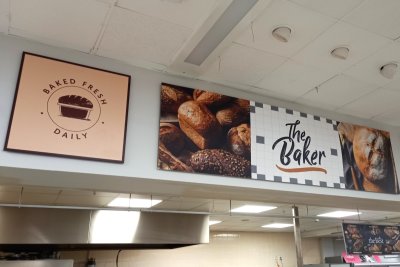
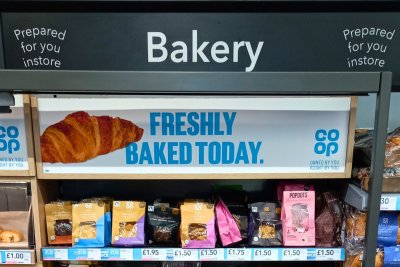
 Re-baked daily. Credit: Chris Young / www.realbreadcampaign.org CC-BY-SA-4.0
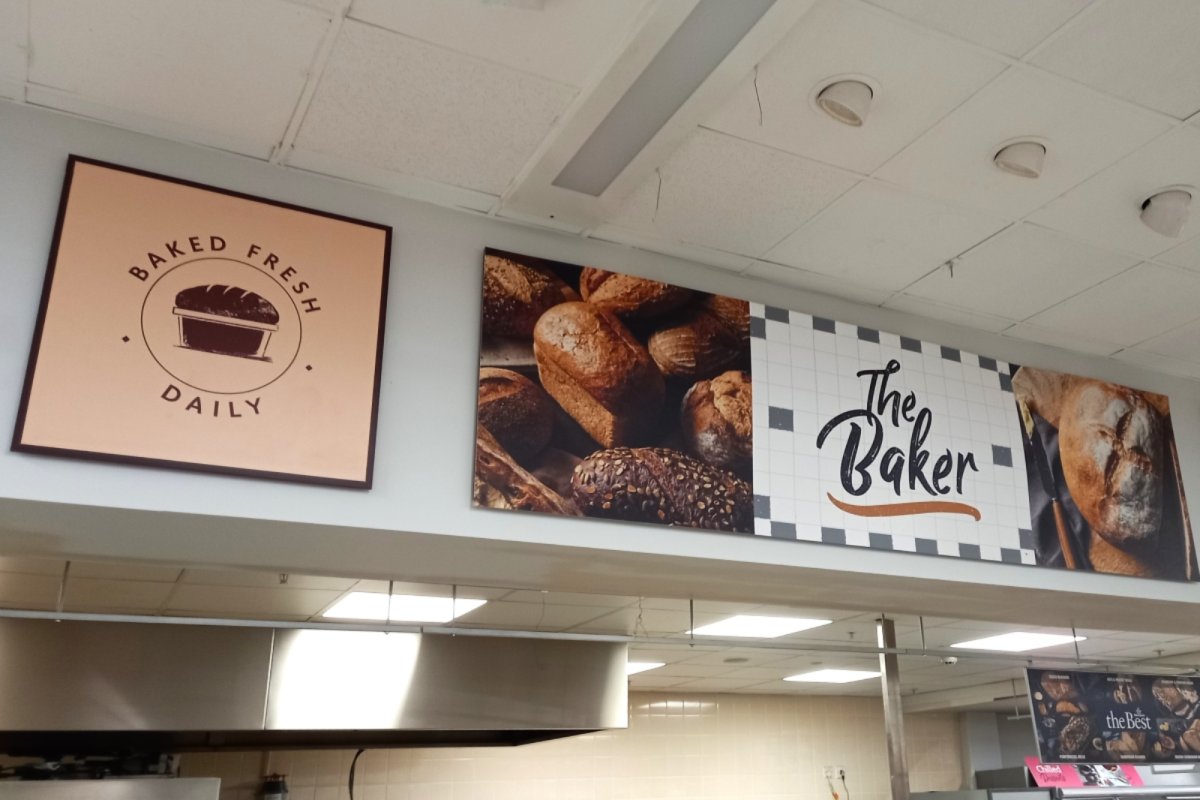

Freshly faked by Morrisons?
The Real Bread Campaign’s trading standards complaint.
Morrisons, the UK’s fifth largest supermarket chain, markets products in ‘The Baker’ section of its stores using claims including 'baked fresh daily', 'baked right here' and 'baked here every day'. The company reinforce these messages on its website, and by displaying the products in ways that are distinctly different from merchandising in the rest of the store.
The Real Bread Campaign has found that Morrisons uses such marketing at stores where no bread is freshly made from scratch on site, instead re-baking products that were manufactured elsewhere.
Believing that such marketing is misleading and breaches consumer protection regulations, on 11 June 2024 the Campaign sent a complaint to Wakefield Council, Morrisons’ Primary Authority for trading standards.
To be clear, this complaint is not that Morrisons is making cheap products widely available, it is about how the company is marketing them.
Morrisons’ silence
To ascertain the general picture, on 30 May 2024 the Campaign emailed the following questions to the customer services team:
- How many stores does Morrisons operate in the UK?
- At how many of these stores are all bread products in 'The Baker' section made and baked fresh from scratch on site?
- At how many of these stores are all bread products in 'The Baker' section made elsewhere and then re-baked in-store?
- At how many of these stores are bread products in 'The Baker' section a mix of lines made and baked fresh from scratch on site, and lines made elsewhere and then re-baked in-store?
- How do shoppers find out whether or not all bread products in in 'The Baker' section of a particular store are made and baked fresh from scratch on site?
A customer services agent twice declined to answer the questions ‘due to limited access’. The Campaign then emailed the questions to the company’s press office on 3 June 2024, following up on the 6th and 7th, but did not receive a reply.
A re-baked product is not freshly made or freshly baked
FSA guidance states: ‘Terms such as “freshly baked”, “baked in store” and “oven fresh” may mislead consumers into believing that they are being offered products that have been freshly produced on site from basic raw materials. Some stores sell bread made from part-baked products that have been packed in an inert atmosphere or frozen off-site then “baked off” at in-store bakeries. Use of terms like “freshly baked”, “baked in store” and “oven fresh” on these products could potentially infringe the general legal provisions…’
These provisions include Regulation (EC) No 178/2002, which states that ‘it is a general principle of food law to provide a basis for consumers to make informed choices in relation to food they consume and to prevent any practices that may mislead the consumer.’ More specifically, Regulation (EU) No 1169/2011 requires that ‘food information shall not be misleading, particularly: (a) as to the characteristics of the food and, in particular, as to its nature, identity, properties, composition, quantity, durability, country of origin or place of provenance, method of manufacture or production.’
Morrisons uses the claims 'baked fresh daily', 'baked right here' and 'baked here every day' at stores in which pre-made ‘bread’ products are merely loaded into what the Campaign calls loaf tanning salons - ovens in which they’re re-baked to brown and crisp the crust. Alongside ‘bread’ products, pastries might be made elsewhere and receive their first baking in a Morrisons store but this is still not what the average consumer would understand such claims to mean.
As no ‘bread’ product is ‘freshly baked’ or ‘freshly baked’ in such stores, the Campaign believes that Morrisons’ use of these claims to market them is misleading and breaches the regulations.
Online claims
Under a banner of ‘More bread freshly baked in store’, a page on the Morrisons website claims: At Morrisons you'll find more bread freshly baked in store than any other supermarket. Head to our Market Street Baker's counter for 27 varieties of fresh bread, baked in store every day.’ The page also states ‘we bake our fresh bread from scratch right here’ claim, twice.
Clearly these claims do not apply to all Morrisons’ stores. The Campaign believes that Morrisons failing to state which do not, or providing shoppers a simple way to find out, is misleading and breaches the regulations.
Facts frozen out?
Shoppers have the right to know if a product has been re-baked as the process uses around twice as much energy as baking a product once and so can have a negative environmental impact. Re-baking also has a negative impact on the quality of a product in that it is likely to stale more quickly than genuinely fresh bread that has only been baked once. This has potential for negative environmental impact as it increases the risk of food waste in the home, at a financial cost to the shopper.
Regulation (EC) No 178/2002 requires that: ‘The name of the food shall include or be accompanied by particulars as to the physical condition of the food or the specific treatment which it has undergone (for example, powdered, refrozen, freeze-dried, quick-frozen, concentrated, smoked) in all cases where omission of such information could mislead the purchaser.’
Due to the company’s reticence to answer the Campaign’s questions, it is unclear if / to what extent Morrisons follows the common supermarket practice of selling products that were made, baked and then frozen at one site, to be transported to and re-baked at another. The Campaign believes that doing so without declaring at point of sale (or on its website) that this has taken place would breach this regulation and section 6 on misleading omissions of The Consumer Protection from Unfair Trading Regulations 2008 in that ‘the commercial practice omits material information’. This would be compounded by stating that such products are 'baked fresh daily', 'baked right here' and 'baked here every day'.
Misleading merchandising?
Article 16 of Regulation (EC) No 178/2002 requires that the: ‘presentation of food or feed, including their shape, appearance or packaging, the packaging materials used, the manner in which they are arranged and the setting in which they are displayed, and the information which is made available about them through whatever medium, shall not mislead consumers.’
Displays in ‘The Baker’ section of Morrisons stores include slatted wooden shelving, which is markedly different from the painted white metal shelves used in the rest of the store. The Campaign believes that Morrisons presenting re-baked factory products as if freshly-made in an artisan bakery breaches this regulation, particularly as it amplifies - and is amplified by – the ‘freshly made in store’ and ‘freshly baked in store every day’ claims, in a mutually-reinforcing marketing echo chamber.
Unfair competition?
Being able to profit from thousands of high margin, non-bakery items, Morrisons can sell ‘The Bakery’ products at low prices. This is enhanced by the economy of scale of centralised manufacture of a number of products (which, in some stores’ cases, is all) sold in ‘The Bakery’.
The company, however, still markets mass-produced, re-baked items using claims and merchandising that will lead the average consumer to believe the products have been freshly made from scratch on site by skilled bakers, as they are in not only some Morrisons’ stores by also in small bakeries. The Campaign believes that Morrisons’ marketing represents unfair competition with these small, independent businesses that create skilled, meaningful jobs, and help to keep money circulating in local economies.
A long time ago in a bakery far, far away?
Regulation (EU) No 1169/2011 requires that: ‘The indication of the country of origin or of the place of provenance of a food should be provided whenever its absence is likely to mislead consumers as to the true country of origin or place of provenance of that product.’ The regulation goes on to state: ‘In all cases, the indication of country of origin or place of provenance should be provided in a manner which does not deceive the consumer and on the basis of clearly defined criteria which ensure a level playing field for industry and improve consumers’ understanding of the information related to the country of origin or place of provenance of a food.’
The Campaign questions whether, in common with other multiple retailers, some products in ‘The Bakery’ are made outside the UK, but not declared on labels or point of sale displays.
If Morrisons is selling re-baked products that were manufactured outside the UK, without disclosing their true origins, the company is depriving shoppers of important information that the Campaign believes further contributes to unfair competition with bakeries that make bread fresh from scratch in the UK. If Morrisons is misleading customers by omission in this way, the company’s claims and merchandising would serve to reinforce the breach of regulations.
See also
Help us expose the (not so great) British fake off
Updates
(WYJS = West Yorkshire Joint Services, which has the Primary Authority relationship with Morrisons for trading standards. LBTH = London Borough of Tower Hamlets Council, Sustain/the Real Bread Campaign's local authority.)
6 February 2026: LBTH advised that Morrisons (again) promised to correct its half-baked labelling and marketing. We replied 'Morrisons previously promised to remove the incorrect and misleading claims back in July 2024. We hope that the company now will actually ensure that happens across all of its stores.'
4 February 2026: LBTH replied: 'I will raise these claims with the Primary Authority to look into.'
27 January 2026: On 23 January 2026, the Campaign found signs in 'the Baker' section of Morrisons, which promised shoppers products were 'made from scratch in our in-store bakery', 'baked in store from scratch' and 'made in store from scratch using British flour'. We submitted this latest evidence to LBTH.
1 October 2025: We replied to WYJS, asking two questions:
- Is WYJS investigating our complaint, as requested by both LBTH and Croydon?
- As / if LBTH, Croydon and WYJS will not correspond with us further about our complaint, can you suggest how we can learn of progress (if any) that is being made?
We also wrote to LBTH: 'As I understand (and for more than 16 years have experienced), the process for complaints is for the plaintiff to submit a complaint to the trading standards department of their local authority for investigation, even if the company in question does not operate in that area.
If the company in question has a PA relationship, the LA might then liaise with the PA or pass the case on, with the LA remaining the plaintiff’s contact for correspondence.
Citizens Advice is increasingly taking on a ‘triage’ function, assessing complaints and deciding whether they merit passing on to the plaintiff’s LA for investigation.
In an effort not to add to your workload (and that of Citizens Advice) in playing go-between, and also in the hope of reducing the time these cases take, sometimes I contact a company’s PA direct. Some are willing to work in this way (though might later point me in your direction to act as my point of contact), others remind me the standard process is to submit the complaint to, and correspond with, you.
In this particular case, WYJS were willing to correspond with me direct, but then decided to revert to the standard process. As Croydon is neither our LA or Morrisons’ PA, WYJS suggesting deviating from the standard process by bringing a third LA into the equation seemed unnecessary, but I gave it a go. This proved to be a dead end that wasted Croydon’s time and mine.
Which is a long-winded way of getting to my point: though our complaint is being investigated by WYJS at your (and Croydon’s) request, my point of contact remains LBTH, as per standard procedure for trading standards complaints. Is that not correct?'
25 September 2025: WYJS replied: 'our role as Primary Authority is to act as single point of contact for other regulators, we do not engage directly with individual complainants.'
17 September 2025: We asked WYJS for an update.
22 July 2025: LBTH replied: 'As advised in previous correspondence, there are no Morrisons in our area so it was best raising the case with the store where issues were noted. Croydon has confirmed they will not be taking further action. Please see with them directly if you wish to know the rationale. The PA is also aware but will not liaise with you direct as this is our partnerships generally operate. Not sure this helps but this is where things stand.'
17 July 2025: Croydon replied, simply repeating what they wrote on 16 July.
16 July 2025: Croydon replied: 'As you are aware, following the concerns raised by you in connection with the bakery signage in Morrisons at Purley Way Croydon, the matter has been referred to West Yorkshire Trading Standards in their capacity as primary authority for Morrisons. I understand that the matter has been noted by them. Croydon Trading Standards are unable to take any further action in regard to this matter. Thank you for drawing it to our attention.'
We emailed an outline of the (so far) 13 month case history to the trading standards officers at WYJS, LBTH and Croydon with whom we've been corresponding. We asked that they decide between themselves and let us know which one of them will take responsibility for fulfilling this duty by resolving this case, and their timescale for doing so.
6 June 2025: We asked Croydon to check what progress WYJS has made with this case in the past seven and a half weeks.
Croydon replied that they had emailed WYJS for an update.
15 April 2025: Croydon responded: 'We are a small team and since this concerns materials supplied by and instructions received from the Morrisons head office, it is appropriate that it is dealt with at a national level. Having reviewed your email, we intend to refer these matters to the Primary Authority for Morrisons to raise with them.'
10 April 2025: As advised by WYJS, we emailed full details of the case to the trading standards department of Croydon Council, where an officer will now have to spend time starting from scratch.
Minutes after emailing Croydon, we received a reply advising: 'We are unable to deal directly with your referral, request or complaint,' referring us to the Citizens Advice Consumer Service.
Citizens Advice does not appear to publish a contact email address to which we can send our compliant and associated written and photographic evidence. We tried the 'Chat with an adviser online' but the on-screen message said 'All our advisers are busy - try again later' and the online form option is only available between 5pm on Friday and 9am on Monday.
We were later able to use the chat facility but were again advised that the only way to submit our written complaint and evidence to Citizens Advice would be at the weekend, outside regular office hours. Eventually, the advisor agreed to raise a case with Croydon's food safety team and gave us that department's email. We sent our complaint to Croydon's food safety (rather than trading standards) team, who soon replied that they had passed it on the the trading standards team.
A trading standards officer responded: 'We will contact West Yorkshire Joint Services about this matter.'
8 April 2025: Despite this being the latest evidence in an existing, national case, the investigating officer at WYJS declined to continue handling it. Instead, the officer advised we should direct this evidence to the trading standards service responsible for the local authority area in which this particular store is based.
31 March 2025: We submitted the latest evidence in the case to WYJS.
28 March 2025: An officer at LBTH wrote: 'With regards to Morrisons, we do not have any shops of this brand in our borough. It was communicated to you on 11th of December that we would not take the matter further.'
'We do not investigate issues falling fully outside our jurisdiction. We may at times and on a case-by-case basis follow it up with a primary authority (more likely where we have branches in the borough) but this is not a blanket approach. On this occasion and as already outlined in my email below, we will not pursue or investigate this matter.'
24 March 2025: An officer at LBTH replied: 'I believe I have already addressed your queries but let me get back to my emails and verify.'
21 March 2025: We emailed LBTH to again say that we have not received any previous response and again asked them to resend it/them.
12 March 2025: We emailed LBTH to again say that we have not received any previous response and again asked them to resend it/them.
3 March 2025: We emailed LBTH to again say that we have not received any previous response and again asked them to resend it/them.
5 February 2025: We emailed LBTH to again say that we have not received any previous response and again asked them to resend it/them.
11 December 2024: LBTH responded: 'As per my previous emails, this is just to confirm that we will not take the matter further.' We replied that we have not received any previous response from LBTH and asked them to resend it/them.
18 November 2024: We again emailed WYJS and LBTH, asking for an update on the progress they have made on this case since 31 July 2024.
25 October 2024: We emailed WYJS and LBTH, asking that one of them update us on the progress they have made on this case in the 12 weeks since our email of 31 July 2024.
3 September 2024: As per LBTH's email of 28 August, we again asked WYJS for an update. WYJS advised us we needed to contact LBTH. We emailed both local authorities, asking them to decide between them who will take it from here and respond to our email of 31 July.
28 August 2024: We asked LBTH to confirm they had received our complaint and passed it on to WYJS. LBTH replied: 'When we refer a matter over to another Local Authority, it is their responsibility to keep you updated on their investigation. Please liaise directly them to query why you have not been updated.' We therefore contacted WYJS again.
19 August 2024: We asked LBTH to confirm they had received our complaint and passed it on to WYJS.
31 July 2024: Morrisons admits products not made in store from scratch. We asked WYJS to review other points of the case. WYJS said we needed to refer the case back to London Borough of Tower Hamlets, which we did.
4 July 2024: Investigations by BBC researchers for a Morning Live item on these cases revealed that Morrisons was using the claim ‘made in store from scratch’ to market 'Bakery' products that were not made in store from scratch.
12 June 2024: Wakefield Council replied that West Yorkshire Joint Services is Morrisons' Primary Authority for trading standards, copying in the relevant officer at WYJS.

Real Bread Campaign: Finding and sharing ways to make bread better for us, our communities and planet.




Sustain
The Green House
244-254 Cambridge Heath Road
London E2 9DA
020 3559 6777
sustain@sustainweb.org
Sustain advocates food and agriculture policies and practices that enhance the health and welfare of people and animals, improve the working and living environment, promote equity and enrich society and culture.
© Sustain 2026
Registered charity (no. 1018643)
Data privacy & cookies
Icons by Icons8
