

 Good Food Bill. Credit: Sustain

Over 100 food businesses, NGOs and academics call for ‘Good Food Bill’ as failing food system threatens national security and public health
Sustain joins major UK food businesses, NGOs and academics in calling for new law as failing food system threatens national security and public health.
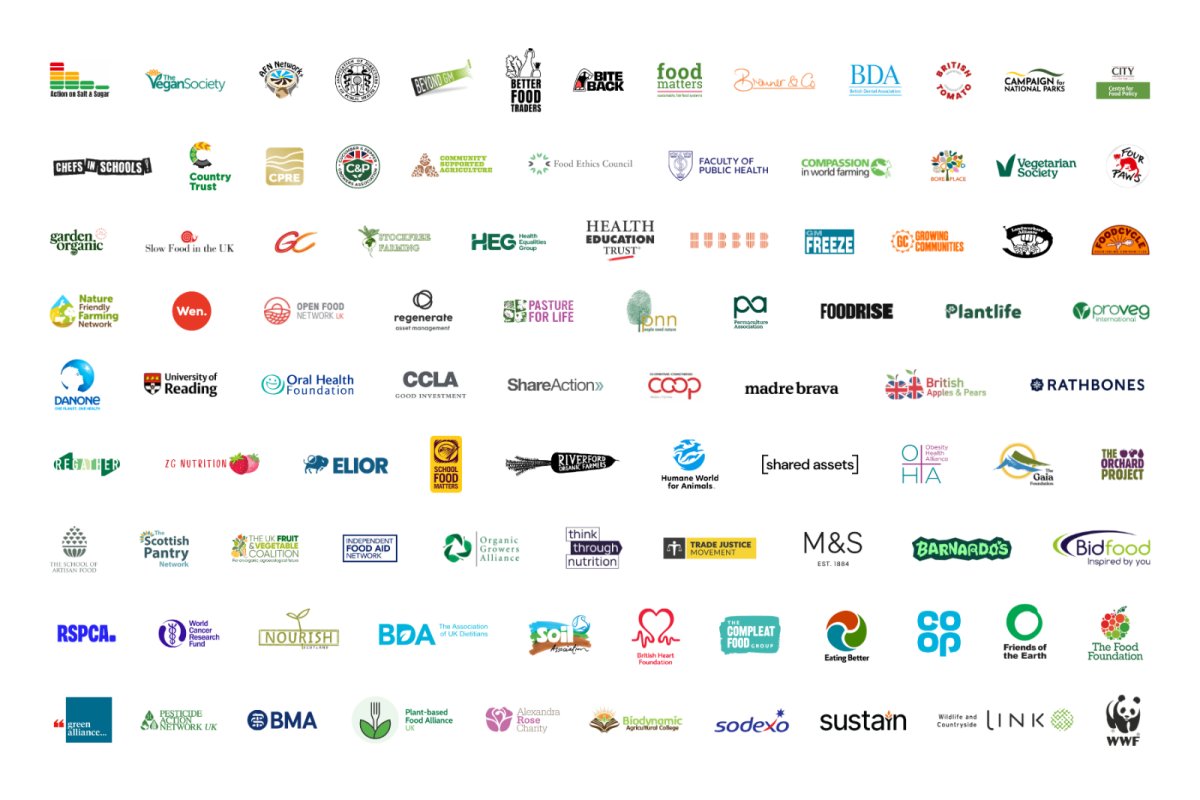
More than 100 major UK supermarkets, food businesses, investors, NGOs and academics have put their names to a joint statement calling for Government to introduce a new ‘Good Food Bill’ to transform the UK’s food system and ensure food and nutrition security for current and future generations.
According to new polling released by The Food Foundation:
-
69% of people think the UK Government should be doing more to ensure everyone can afford and access healthy food
-
65% of people support the introduction of a ‘Food Bill’ that would put in place new duties and targets on government and government bodies to make healthy food more accessible and affordable
-
Half (53%) of people think the current state of international affairs has made protecting the UK food supply ‘more important’
The UK’s food supply is facing unprecedented challenges. Last month the Government’s own research warned that in the increasingly likely event of continued biodiversity loss and the collapse of vital ecosystems, the UK could face food shortages, increased food prices and a threat to national security. With the nation still suffering the effects of the cost-of-living crisis and the highest food price inflation for 40 years, triggered by Russia’s invasion of Ukraine and the aftermath of the global Covid19 pandemic, policy makers must now take action to protect the UK’s food system from further global shocks, an increasingly turbulent international context, ongoing extreme weather patterns and inflation.
Today more than 100 major UK retailers, food businesses, investors, health organisations, food and farming NGOs and academics are calling on the UK Government to introduce a ‘Good Food Bill’ to protect citizens, farmers and food businesses. This would be a piece of legislation and a once-in-a-life time opportunity for the UK Government to set out a visionary plan to transform the food system. It would enshrine in law policies, targets and ambitions to improve public health, reduce inequalities, protect the environment and improve UK resilience, while safeguarding progress from short-term political cycles.
Businesses including Marks & Spencer (M&S), Danone, Co-op Group, Bidfood, The Compleat Food Group and major caterers Elior and Sodexo are standing alongside NGOs including The Food Foundation, Sustain, Green Alliance, Barnardo's and WWF, as well as health organisations like the British Medical Association, British Heart Foundation and the British Dental Association with a shared call for a ‘Good Food Bill’.
These issues are also of key importance to the electorate, and The Food Foundation has today released YouGov data showing 69% of people think the UK Government should be doing more to ensure everyone can afford and access healthy food, with only 3% saying they should be doing less. On top of this, half (53%) of people think the current state of international affairs has made protecting the UK food supply ‘more important.’ Support for action cuts across political divides, with 65% of people supporting the introduction of a government ‘Good Food Bill’ that would put in place new duties and targets on government and government bodies to make healthy food more accessible and affordable (1).
We already have a situation in the UK where 15% of households with children report experiencing food insecurity and where healthier foods are more than twice as expensive per calorie than less healthy foods and less available, type 2 diabetes is rising among young people, and 36% of children are living with overweight or obesity by secondary school. This demonstrates that major change is needed in the food system if Labour is to achieve its election manifesto pledges to ‘raise the healthiest generation of children ever’ and ‘end mass dependency on emergency food parcels.’ A ‘Good Food Bill’ would put into place the long-term duties required by government to deliver these important wins.
It has now been 14 months since the Government first set out its ambition for a food strategy and with the next King’s Speech approaching, now is the prime opportunity to commit to a White Paper as a precursor to a ‘Good Food Bill’ to lock in the government’s ambition for a healthier, more resilient, sustainable food system.
Anna Taylor, Executive Director, The Food Foundation, said:
“A Good Food Bill would provide the durable policy foundation needed to transform the food system for generations to come. Governments can achieve important wins within a single term, but only legislation can lock in change, providing certainty and protecting progress from shifting political priorities. With food strategies and legislation already in place across the devolved nations, this is a timely opportunity for Westminster to introduce legislation that benefits the whole UK. We are calling on the Government to seize this moment, commit to new primary legislation and lead the change needed to build a food system fit for the future.”
Kath Dalmeny, Chief Executive, Sustain: the alliance for better food and farming said:
"A Good Food Bill would give farmers, growers, businesses and communities the long-term certainty they need to invest in sustainable practices. The UK currently has very little strategic oversight to ensure everybody gets properly fed. But through smart investment, aligned trade policy and the right targets, legislation can unlock opportunities for growth, build resilient supply chains, and create a food system that works from farm to fork - supporting sustainable farming, protecting public health, and ensuring nobody goes without healthy, nutritious food in a country as wealthy as our own."
Lydia Collas, Head of Natural Environment, Green Alliance, said:
“The breadth of this coalition – from major supermarkets to health experts – shows the need for a step change in the government’s approach to food policy. We are living in an age where global shocks and climate change are already having major impacts on our food system, leaving more people struggling to access healthy food. A Good Food Bill would provide a statutory imperative for this government, and those that follow, to make concerted progress towards everyone having access to healthy and sustainable food.”
Julie Owst, Head of Sustainability, Bidfood, said:
"We need a “Good Food Bill” more than ever – it’s not just a ‘nice to have’. On the back of the recent UK government report into growing threats to national security and food availability and affordability, we absolutely need intervention and legislation to improve UK food supply resilience, and the livelihoods and productivity of those working to provide food – as the current trajectory means the needs of the UK population won’t be met – and this inconvenient truth needs acknowledgement and action."
David Moore, ESG Director at The Compleat Food Group, said:
“At The Compleat Food Group, our mission is to create food to feel good, a principle that guides everything from the delicious food we make to the way we operate sustainably. Supporting the Good Food Bill reflects our belief that long-term, systemic change is urgently needed to build a healthier, fairer and more resilient food system.
We are proud signatories because this legislation would provide business, farmers and communities the framework to drive progress and ensure nutritious, affordable food is accessible to every household.”
Professor David Strain, BMA Board of Science Chair, said:
"The BMA supports a 'Good Food Bill' and supports the focus on improving the UK's food environment, because, as our recent report, Improving the nation's health: the impact of ultra-processed food, highlights, not enough is being done to halt rising obesity levels and preventable diesase, particularly among children. Doctors are seeing the consequences of poor diet every day. We support measures that strengthen regulation, increase industry accountability, and make healthier, minimally processed foods more accessible and affordable, as meaninful reform is essential to protect public health and ease pressure on the NHS."
Stephanie Mathern, The First Thirty Ventures, said:
"Having a food bill in place that gives farmers, food processors, food businesses and investors a clear legislative framework for the long-term will unlock large scale, much-needed investment across the industry - from seed funding for new technologies to capex for established businesses. This will undoubtedly translate to higher growth figures for our economy."
Tim Lang, Professor Emeritus of Food Policy, Centre for Food Policy, City St George’s, University of London, said:
“If getting prepared to feed the public well in times of shock was taken seriously, we’d have to redesign the food system to make that happen. Placing a duty on authorities to be able to feed all the public well in crises means civil food resilience becomes real. We cannot just trust to luck or big retailers to feed us in crises. Food resilience is a common good. Such a duty would mean food is taken as seriously as the energy system. If we can plan to keep the lights on, why not plan to keep people fed?”
Yusuf, Food Foundation Young Food Ambassador and school student in London said:
“I believe 69% of the public think the government should do more because access to healthy food is no longer guaranteed for many families. A Food Bill would show that the government is serious about long-term solutions, not short-term fixes, by making food security, health and fairness a legal priority. As a Food Ambassador, this matters to me because no child should grow up hungry or excluded due to circumstances beyond their control, and clear legislative targets are essential to tackling obesity and food insecurity in a lasting, accountable way.”
FOOTNOTES
1) All figures, unless otherwise stated, are from YouGov Plc. Total sample size was 2,070 adults. Fieldwork was undertaken between 27th - 28th January 2026. The survey was carried out online. The figures have been weighted and are representative of all GB adults (aged 18+).

Sustain: Sustain The alliance for better food and farming advocates food and agriculture policies and practices that enhance the health and welfare of people and animals, improve the working and living environment, enrich society and culture and promote equity.

Sustain
The Green House
244-254 Cambridge Heath Road
London E2 9DA
020 3559 6777
sustain@sustainweb.org
Sustain advocates food and agriculture policies and practices that enhance the health and welfare of people and animals, improve the working and living environment, promote equity and enrich society and culture.
© Sustain 2026
Registered charity (no. 1018643)
Data privacy & cookies
Icons by Icons8
