

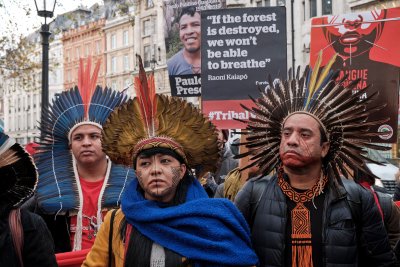
 14 November 2019. Indigenous leaders from Brazil protesting outside the Embassy in London to demand end to destruction of lands and people.. Copyright: Wandering views | Shutterstock

Big Ag at COP and at home: a deep dive from the front lines
At the latest COP, once again flooded with corporate food and farming lobbyists, the industry continued to position itself as essential to global food security, despite persistently being a key driver of deforestation, greenhouse gas emissions and ecological collapse. The same story is happening in the UK, where Big Ag enjoys easy access to government and attempts to side-step local democracy. So how can we avoid these traps and position ourselves in solidarity with farming communities?
What does a rural community in Norfolk have in common with the Alter do Chão community in Brazil? Far more than geography might suggest. Both are witnessing accelerating environmental degradation driven by the global expansion of intensive livestock production. Both find their voices sidelined in corridors of power. And both are fighting to protect lands they are deeply connected to from the same powerful agribusiness interests shaping decisions far beyond their borders.
While Big Ag has rightfully received heat for the effect of its inflated presence at this year’s COP talks, we need to be just as vigilant to its tactics in the UK. In both arenas, Big Ag enjoys privileged access to power.
Weakening ambition on the global stage: how did a call to end deforestation disappear?
This year’s talks took place in the heart of the Amazon basin, where it was hoped that it would deliver a clear roadmap for both phasing out fossil fuels and ending deforestation. However, after weeks of negotiations, the final text made no mention of fossil fuels and included no binding commitment to halt deforestation, despite backing from more than 80 countries (including the UK), a vocal desire from Brazil's own Climate and Environment Minister and the demands of indigenous communities, some of whom which stormed COP proceedings last week to call time on climate delay and deforestation.
This is not the moment for delay: with climate collapse already being acutely felt in extreme weather events, falling crop yields and unprecedented temperatures across the globe, dire warnings about the ‘fall back’ of the coral reef and the first global climate tipping point, this was the moment for bold action – a beginning of the end of fossil fuel finance and our destructive food system, instead COP30 concluded in voluntary roadmaps and a step backward for global climate action.
“While they talk about energy transition, they release oil into the Amazon’s basin and privatise rivers like the Tapajós for soy. For us, this is not development, it is violence,” said Vandria Borari of the Borari Kuximawara Indigenous Association of the Alter do Chão territory, as reported in the Guardian.
Poor progress on agriculture emissions in past COPs has been attributed to the continued influence of livestock agribusiness interests within the negotiations, with key decisions stopping short of measures that would challenge the sector’s role in driving deforestation and climate breakdown. Last year’s COP ended with Carbon Brief noting that food, forests, land and nature “featured pretty weakly” in the final negotiations after it was reported that 204 food and farming lobbying were in attendance. This year, that was up to more than 300 lobbyists - a joint investigation by DeSmog and the Guardian found that the number of lobbyists representing industrial cattle farming, commodity grains and pesticide interests is up 14 percent on last year’s summit. The Guardian reported that meat and dairy lobbyists accounted for 72 of the 300, a sector that is responsible for 12-19% of human-caused emissions, almost double the delegates from Jamaica, still recovering from the brutal storm Melissa described as the most acute manifestation of ‘environmental racism’, with research showing that “wherever Afro descendants are located, they are most vulnerable to climate and environmental impact and have been suffering from historical environmental injustice and climate injustice.”
The lobby’s inflated presence has been called a corporate capture of COP proceedings. “These findings are proof that industrial agriculture has been allowed to co-opt the climate convention. COP will never deliver real climate action as long as industry lobbyists are allowed to influence governments and negotiators,” said Lidy Nacpil of the Asian Peoples’ Movement on Debt and Development.
The UK picture
It is not difficult to see similarities in what happened at COP and what is happening here in the UK. To start with, there are many of the same companies. Cargill and JBS - infamous players in environmental devastation globally - all operate in the UK. Cargill’s British subsidiary Avara Foods has recently found itself the subject of the UK’s largest environmental lawsuit over pollution from its chicken units into UK rivers.
There are too many easy routes into Westminster for agri-business interests. Labour’s new growth policy has turbo-charged opportunities for Big Ag to apply pressure to weaken regulation historically designed to protect our health and the environment, like planning regulation, while transformative action on climate, livestock and land use is quietly sidelined. The Food Foundation’s State of the Nation’s Food Industry report revealed that between 2020 and 2023, DEFRA ministers held 1,377 meetings with food industry representatives and their trade bodies alone, 40 times more than with civil society organisations. More than this though, Big Ag has steadily moved into positions of power on government advisory boards and trade appointments.
Back in March, the chairman of Cranswick, a billion-pound poultry and pig operator, was appointed to the advisory board of the government’s new Food Strategy weeks after it was revealed their East Anglia farms had breached environmental regulations nearly 100 times since 2017. Tim Smith, former Group policy Director at Tesco, has acted as a key government adviser on environmental policy since 2022 where he sits as co-lead of the Food and Drink Sector Council and a member of the Department for Environment, Food and Rural Affairs’ Food Data Transparency Partnership. The roles give access to government ministers as well as routes to influence key food and environment policies such as how businesses should report on their climate impacts.
The Food Data Transparency Partnership is an initiative involving the UK government, industry stakeholders, academia, and civil society, with the working groups composed of majority industry representatives including 2 Sisters, the NFU, ASDA, Lloyd Banking and AHDB (a government affiliated board that has itself the subject of industry lobbying claims). Its stated aims have been to contribute to climate change mitigation by developing consistent and transparent ways for companies to report on their climate impacts. However, publicly available meeting records indicate that, following internal lobbying, the group failed to deliver mandatory requirements for reporting on health or scope three emissions. The group also canned a promised public consultation.
These are the same livestock corporations advising government about emissions disclosure were embroiled in an emissions scandal only last month. Our own research found that intensive livestock operators, including Cranswick, and subsidiaries of JBS and Cargill, have been submitting proposals for large new facilities in areas already high in factory farms without assessing the likely climate impacts, which is required by law. This has left hundreds of thousands of tonnes of CO2 potentially unaccounted for and councils and communities in the dark about how these corporations are affecting their own targets.
But what happens when, despite all their routes into national government, things don’t go their way at local level? Weeks after the announcement of the food strategy advisory board, we supported a group of committed campaigners to secure a refusal from Kings Lynn and West Norfolk council for a Cranswick megafarm on climate grounds in a win for local democracy and community action. But Sustain has had sight of FOI emails that show Cranswick contacting Minister Steve Reed while planning officers had already recommended to refuse the proposal. In one message sent days before the local planning committee met, the company sent a glossy briefing to government describing criticism of their proposal as ‘factually incorrect’ and pushed familiar arguments around food security and ‘better use of land’.
Days later, a sitting MP forwards a disgruntled Cranswick ‘Government information below in case in supports you at Cranswick. It’s regarding Environmental permit reforms to empower regulators to slash business red tape.”
Jan Palmer, the community campaigner in Norfolk whose request to see the emails was blocked by government for months, said:
"While communities often struggle to have their voices heard - and with their concerns often dismissed - agribusiness leaders are quietly briefed on government reforms designed to ease their passage through the system. This also reflects a deeper pattern where corporate lobbying – which helps shape policy – remains undisclosed and shielded from public scrutiny. The doors around this are closed so tightly that even when requested through Freedom of Information the public is often denied access to this information.
What we see at COP and in Westminster is the same story: when local communities challenges Big Ag, the industry leans on its privileged relationships with those in power to shift goalposts and bypass scrutiny. The result is a global model tilted towards corporate interests, leaving communities and councils sidelined and silenced and extremely concerned about what the changes to the planning bill will mean for them."
Moving forward
Big Ag, whether at COP or here in the UK, has repeatedly shown that its priority is growing production and profit, not delivering the kinds of change we need to feed everyone healthy food and tackle climate change. . From weakening climate ambition at COP to resisting transparency at home, it has positioned itself as part of the solution while actively undermining real progress.
If we are serious about climate action and global food security, we must move away from a model that places corporate agribusiness at the centre of decision-making. The UK can be a leader in a just food transition. Our farmers can and should be supported to produce good food away from the control extractive corporations.
That means:
- Removing Big Ag from positions of power in climate and food policy, including government advisory groups and strategy bodies where conflicts of interest are clear.
- Ending the myth that Big Ag can deliver food security when industrial livestock systems are driving climate breakdown, land degradation and biodiversity loss.
- Holding agribusiness to strict, enforced environmental standards including mandatory reporting across the full supply chain and meaningful penalties for non-compliance.
- Backing a just transition for farmers, with long-term investment and support to move away from intensive livestock production and towards the kinds of foods we need for the future, including more vegetable, pulses, legumes and nuts, and nature-friendly mixed farming methods
- Coming good on commitments to a horticulture strategy, and making this strategy one which places the UK as leaders, investing in , agroecology and short supply chains that prioritise public health and environmental outcomes.
- Accelerating support for alternative proteins and plant-based diets, alongside policies that support a fair dietary shift aligned with climate and health goals.
The future of food cannot be left in the hands of those whose business model relies on extracting profit from rural communities rather than delivering good jobs and creating healthy food. Instead, let’s invest in farmers to produce the kinds of food we need for the future.

Sustain: Sustain The alliance for better food and farming advocates food and agriculture policies and practices that enhance the health and welfare of people and animals, improve the working and living environment, enrich society and culture and promote equity.



Sustain
The Green House
244-254 Cambridge Heath Road
London E2 9DA
020 3559 6777
sustain@sustainweb.org
Sustain advocates food and agriculture policies and practices that enhance the health and welfare of people and animals, improve the working and living environment, promote equity and enrich society and culture.
© Sustain 2026
Registered charity (no. 1018643)
Data privacy & cookies
Icons by Icons8
