
Food connects community health, economic resilience, climate goals, and tackling inequality. Most councils know this, but food work is often fragmented across departments, under-resourced, and not always easy to prioritise.
We can help! Good Food Local is a national programme led by Sustain that gives councils a practical framework for improving their local food system, helping them prioritise effort and make meaningful and measurable progress for health, equity and the environment.
By taking part, councils gain a structured assessment of where they are now, clear recommendations on next steps, connections with other councils doing the same work, and a growing body of case studies, peer learning and good practice to draw upon.
A regional approach to Good Food Local
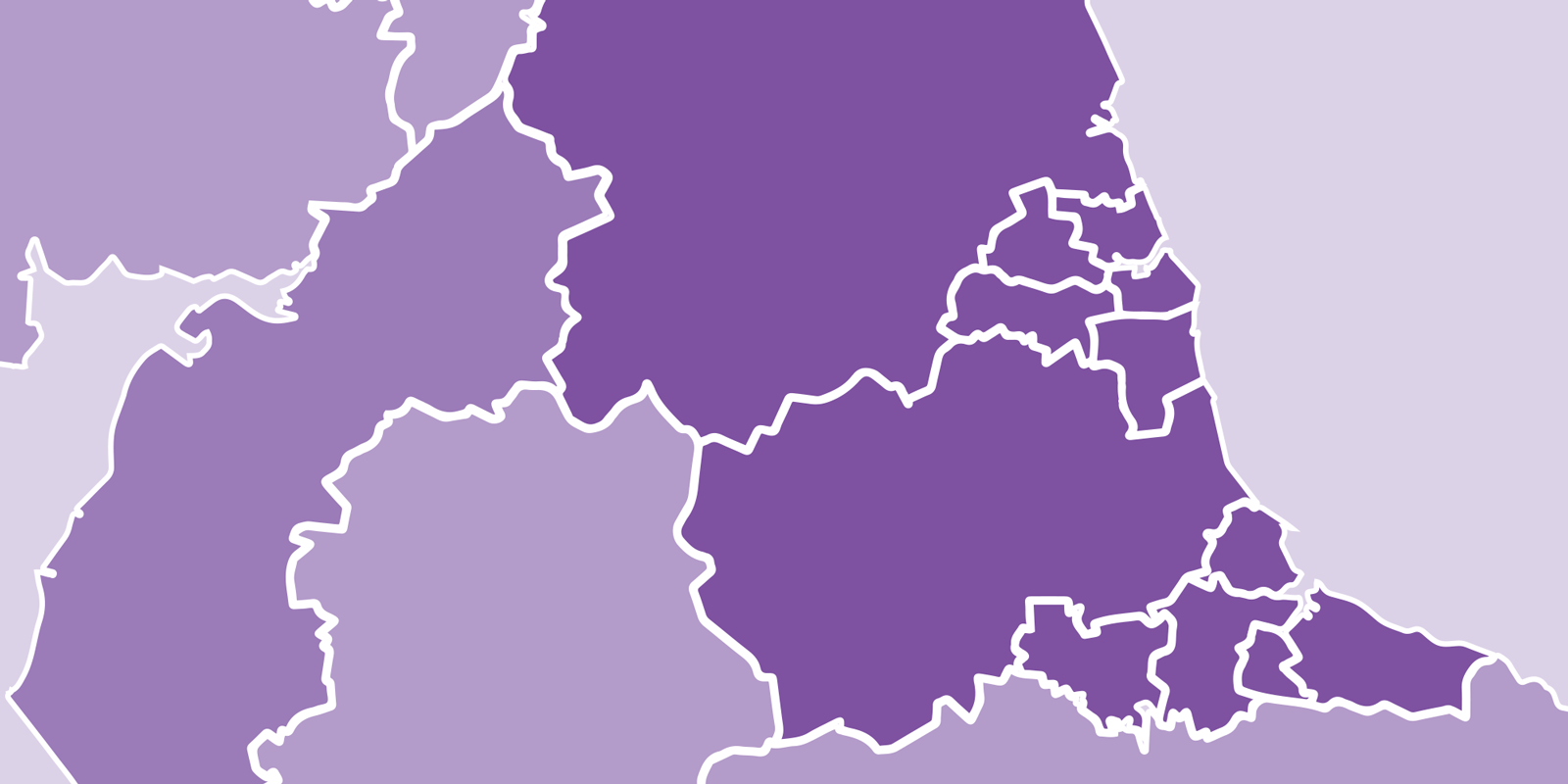
We have seen the benefits of regions taking part in Good Food Local for over 14 years, beginning in London, and more recently in the North East and South West.
Could your region be next?
As well as supporting individual councils to improve their local food system, Good Food Local can support a region:
- To build relationships across councils and lay the foundations for a long-term change process and the development of a connected regional movement with a sense of collective direction, supporting local authorities to feel they belong to something larger than their own authority
- To develop an understanding of shared opportunities and challenges, turning a complex, fragmented picture into a coherent view, with a mechanism for aligning priorities and opportunities for delivery across local authorities
- By developing or strengthening a community of practice and connect councils who are facing the same challenges to share learnings, good practice and experiences
- Through sharing learnings and provision of mutual support to help officers translate lessons from peers into local contexts, with the opportunity for councils to borrow and adapt approaches rather than starting from scratch
- To reinforce the significance of place-based food work across a region and build regional visibility and leadership, celebrating local projects and programmes
- To implement a framework that provides a shared, common language and understanding of food systems thinking
What we can offer:
- Access to a simple to use platform with self-assessment tool, based on the Sustainable Food Places six key themes – completed together as a regional cohort
- Each local authority receives a report summarising their score, plus recommendations
- With the opportunity to feature on the Good Food Local map as a region, plus celebrate place based or regional achievements in case studies and in Sustain newsletters
How delivery works best:
We’ve seen the best results when there is someone in the region committed to supporting the development and delivery of the programme and a timeline of activities. A named person is preferable, who can co-ordinate activity between local authorities and food partnerships including for example:
- Communicating about the assessment framework and convening area leads
- Sharing of resources to support participation
- Keeping to an assessment timetable
- Troubleshooting issues (with Sustain’s support)
- Promotion of participation and sharing of results with networks
Sustain can provide additional, tailored support to drive forward change through:
Participation in systems change workshops:
As a region: Sustain can provide group workshops to a region focussed on collaborative working on food systems change. These workshops bring together colleagues from across the region to learn food systems principles and how they apply to and can support their roles and workstreams, and invite them to collaborate using tools to drive forward food-related health, equity and environmental outcomes.
As an individual local authority: Sustain can provide workshops to individual or neighbouring local authorities so colleagues across departments can identify shared priorities and understand food work in a broader context. Participants are invited to systems map and action-plan on a specific area of priority / interest: set a vision for the system, identify barriers, solutions and opportunities, and develop shared actionable steps.
By prompting officers to speak to new colleagues, map responsibilities, and sit together in shared spaces, our food systems workshops uncover hidden activity and spark conversations that wouldn’t otherwise happen. This strengthens relationships, creates new lines of communication, uncovers areas of cross-departmental work that offer mutual benefit and enables rapid problem-solving across policy areas that traditionally operate in isolation.
Providing a tailored, bespoke report:
Sustain can provide a bespoke Good Food Local regional report detailing trends and recommendations, local case studies and innovative ways for councils to progress their food systems. This can be promoted on a new webpage on our Good Food Local website, see Good Food Local: The London report for an example of a regional report and Good Food Local: The North East for a regional website example.
Participation in a regional roundtable event:
Post publication of results, Sustain can host a regional roundtable event to debrief on participation in Good Food Local assessment as a region, share learning and experiences, and look ahead to support the development of future ambitions. This could also look like a wider celebration event involving partners and other local food organisations.
Develop regional-specific questions:
Sustain can work with you to tailor your future assessment to local needs; understanding better local contexts, schemes and partners to feed into questions.
Are you from an individual LA looking for your region to take part?
Sustain can support you to champion Good Food Local within your region and bring other Local Authorities on board.
Contact us now for more information
More information on Sustain consultancy services.

 Good Food Local: The North East Report 2024. Credit: Sustain

Good Food Local: Supporting local authorities to create more healthy and sustainable food systems in their local areas.
